A hill we did not get up, a housing scheme we chose from the air, and a night the whole city spent shouting about water polo.
Words — Johan
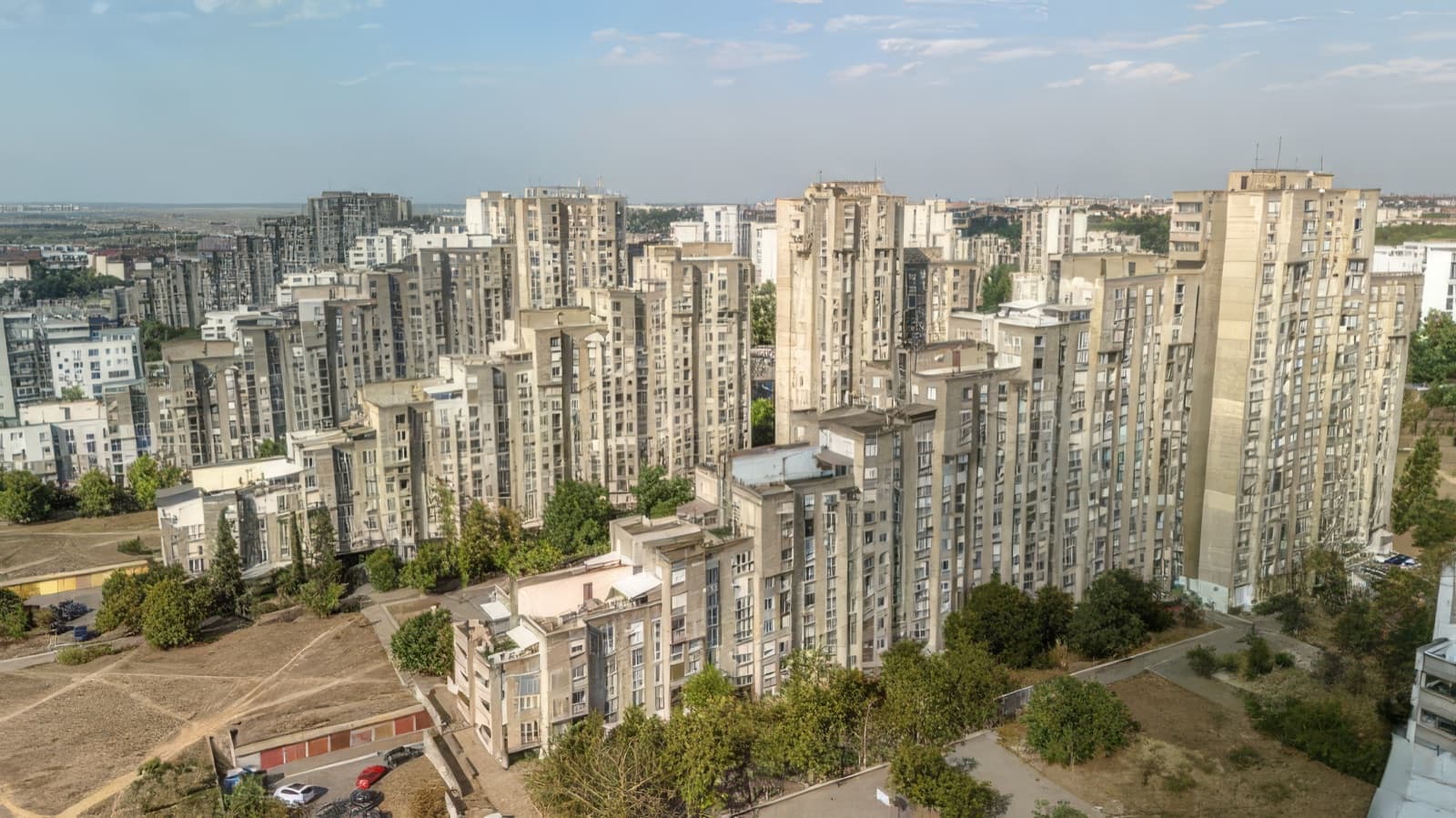
Blok 61, New Belgrade. This is what we looked down at.
B.A.C.U.
We picked the route out of an aeroplane window.
Coming in over the city you see the blocks before you see anything else. Long slabs standing in open ground west of the river, laid out in rows with space between them, numbered rather than named. Blok 61 and the ones next to it. We looked down at that and decided we would run there. None of us said why.
That is where the suburb routes started. Not with a plan. With three men looking out of a window at a housing scheme.
We landed and said, more or less at the same time, that Belgrade does not let its guard down. The city is big and has its own intentions. It will not tidy itself up because you have come to look at it.
Two rivers meet under the city.
The Sava comes in from the west and ends there. It starts in Slovenia, runs about 945 kilometres, touches Croatia and Bosnia on the way, and then goes into the Danube below the fortress and stops being the Sava. Most of the old country drains through it to that one point.
The fortress on the ridge above the meeting was built and rebuilt from the second century to the eighteenth. The city under it has been fought over in 115 wars and levelled 44 times. Those are the figures people here give you, and nobody rounds them down.
Everything is arranged around the water. Old Belgrade stands high on the right bank. New Belgrade lies flat on the plain between the two rivers, west across the Sava. That is where the blocks are.
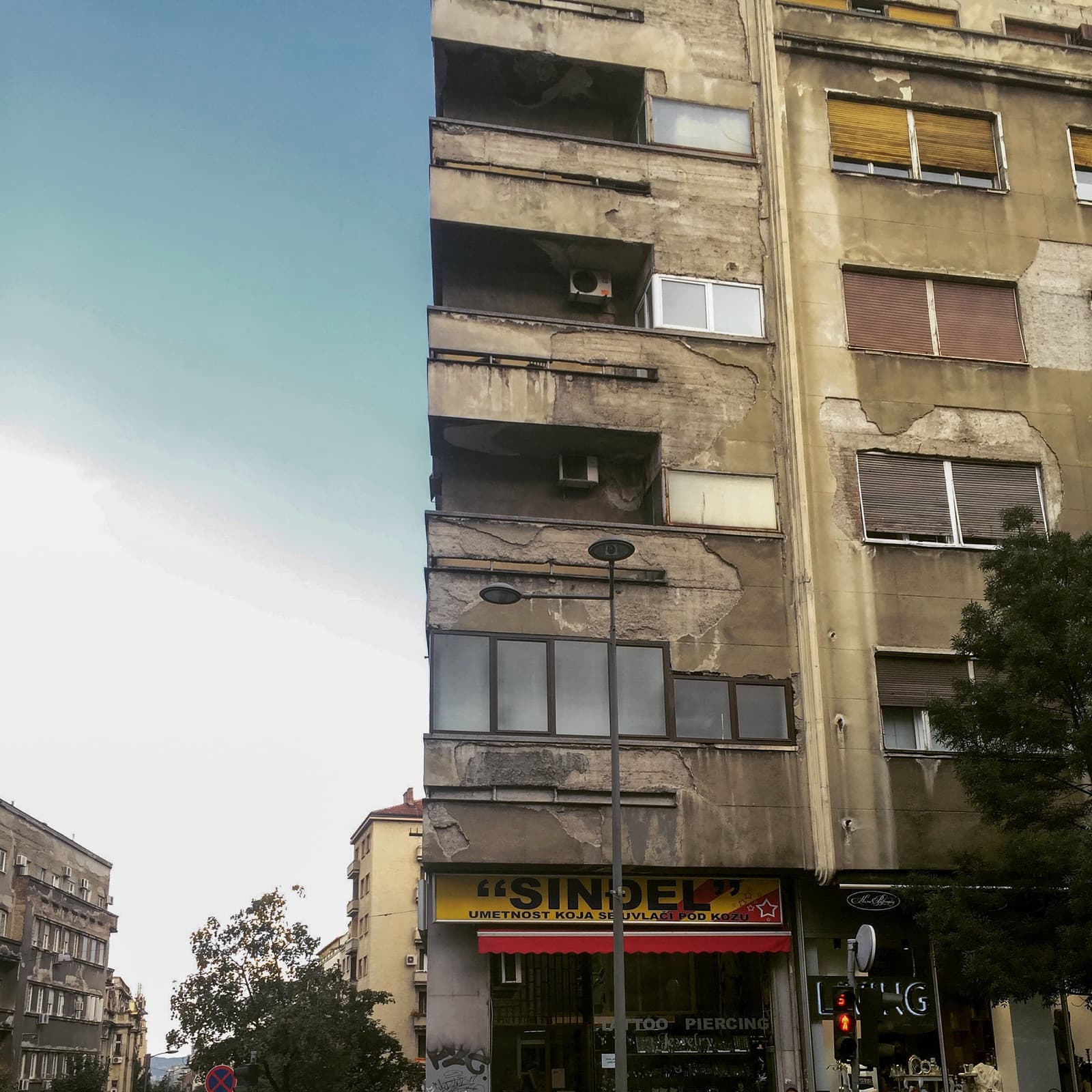
The flat was at 21 Braće Jugovića, in the old town. The facade was broken. The courtyard had been closed in with wire, like a coop. Inside it was grand. Two balconies, high rooms, and a rack of coloured slippers by the door that guests were to wear indoors.
Lina met us at the door with the keys. She had inherited the flat and did not live in it. She was proud of it. I cannot remember what we talked about.
We never cooked. The kitchen was for breakfast and for mixing drinks.
The street is named after the Jugović brothers. There were nine of them, sons of Jug Bogdan, and they are not history exactly. They belong to the epic poems.
In the poems the nine of them ride to Kosovo in 1389 with their father and all ten are killed. There is a poem about their mother. She asks God for the eyes of a falcon and the wings of a swan so that she can fly out to the field and see them, and God gives her both, and she finds them dead. The church still gives out an order named after her to women with many children.
We slept on that street for three nights and did not think about it once.
It was August and it was warm. The nineteenth to the twenty-first.
We had been told there was no television tower to run up, which was true, so we found a hill instead. The plan was to go from the flat up to the Astronomical Observatory on Volgina 7. It is 253 metres up, which does not sound like anything.
The way there goes past Ново гробље, the New Cemetery, on Ruzveltova. We passed it going up and again coming back down.
It opened in August 1886 and was the first burial ground in Serbia that anyone laid out on purpose, planned and built before a single person went into it. Thirty hectares. Somewhere around 340,000 people have been put there since.
It is not one cemetery but several, and the street runs through the middle of them. Military sections for the Serbian-Ottoman war, the Serbo-Bulgarian war, the Balkan wars and both world wars. A Jewish cemetery. An ossuary from 1907 holding soldiers who were dug up from older ground and moved. On the far side of Ruzveltova, the Liberators' cemetery, with 2,944 Yugoslav soldiers and 961 Red Army soldiers from the fighting for the city in 1944, and mass graves holding 1,381 and 711 more.
Past that the road carries on up towards the observatory.
The gradient through the Zvezdara forest was more than we had allowed for. We stopped short of the top.
The hill is called Zvezdara because of the observatory. Before the building went up between 1929 and 1932 the hill was called Veliki Vračar, and the word zvezdarnica simply means a place for stars. The building took the name, then the hill took it from the building, then the whole municipality took it from the hill.
We ran up a district named after a thing we did not reach.
For the blocks we took bus 82.
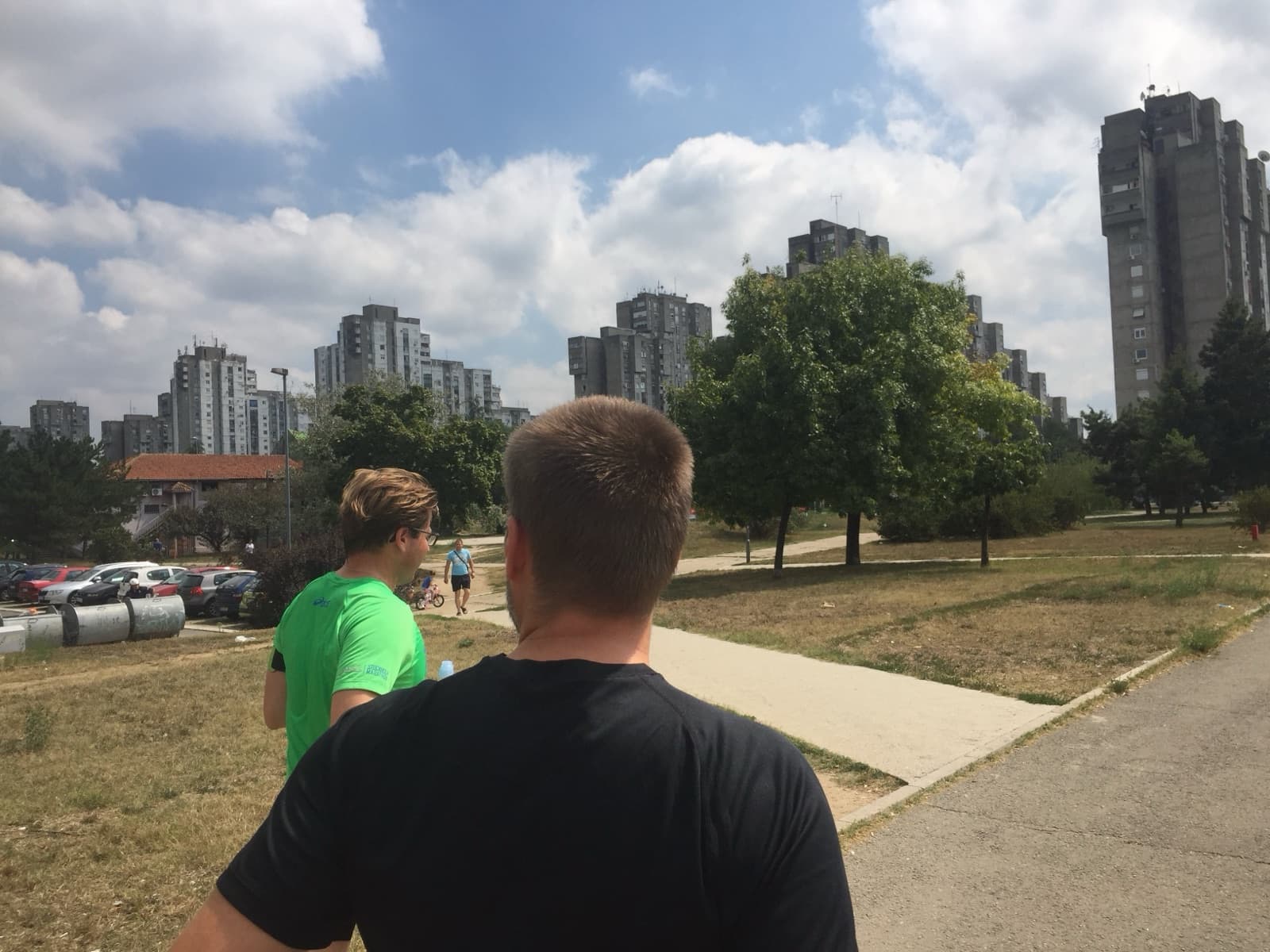
The route ran between Blok 61 and the flat, back east through the brutalist suburbs and over the river. Slab after slab, wide ground between them, everything at a scale that has nothing to do with walking. It was better on foot than it had looked from the air, which is not the same as saying it was pretty.
The worst kilometre was the last one, back over the Stari savski most.
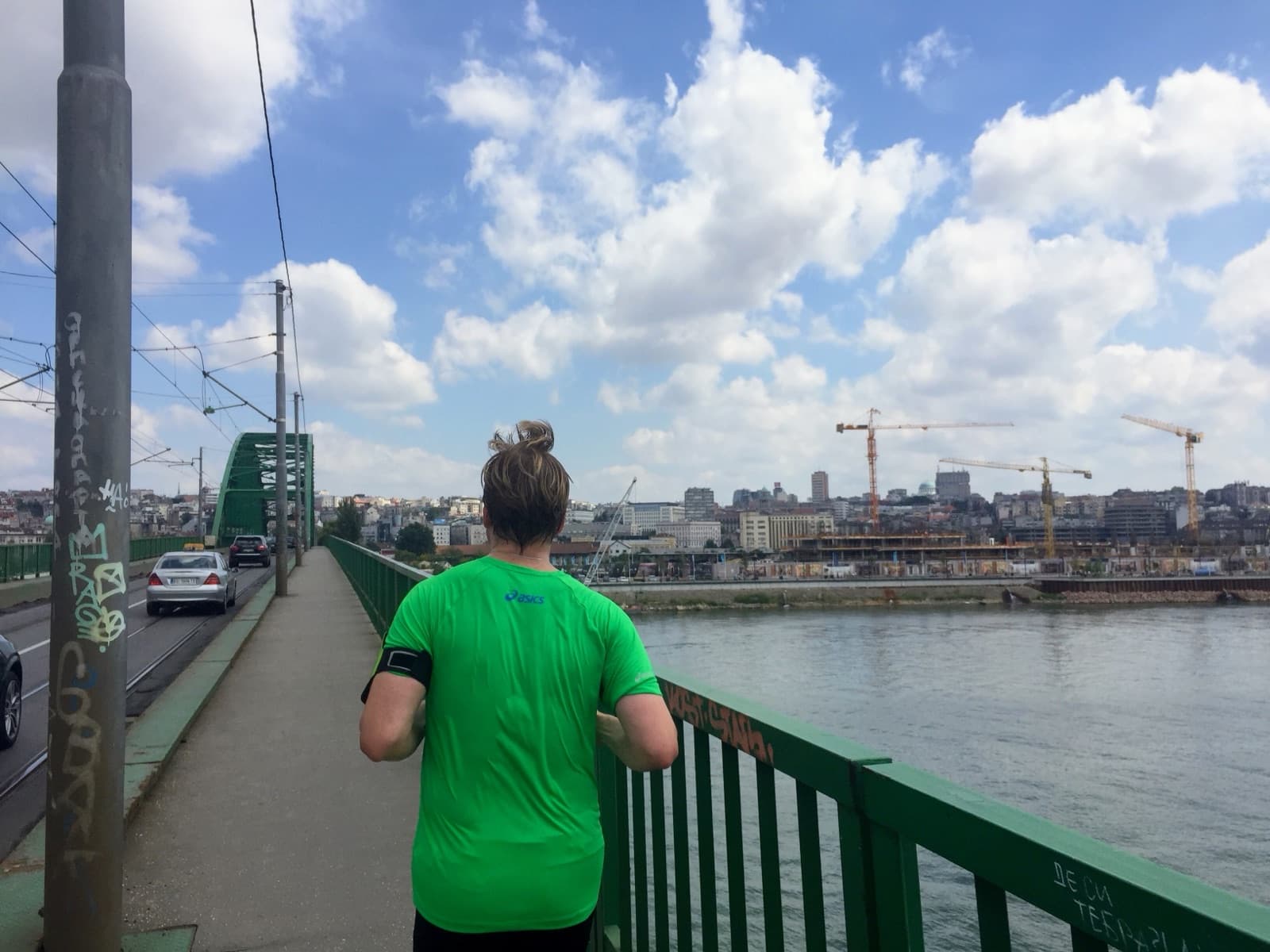
The Germans built it in 1942, during the occupation, because the only road bridge over the Sava had been bombed. It was not even meant for Belgrade. A firm in Dortmund had made it to span the Tisa up near Žabalj and the Germans sent it here instead.
In 1944, retreating, they mined it. A schoolteacher called Miladin Zarić went out and cut the wires. It was the only large bridge in Europe the Germans failed to bring down on their way out.
Tram tracks went on in 1984. Green steel, four hundred and thirty metres, the smallest road bridge in the city, and a walkway along the side of it for people on foot.
The city started taking it down in November 2024. They lifted the arch off in one piece by barge on 30 July 2025. It is not there any more.
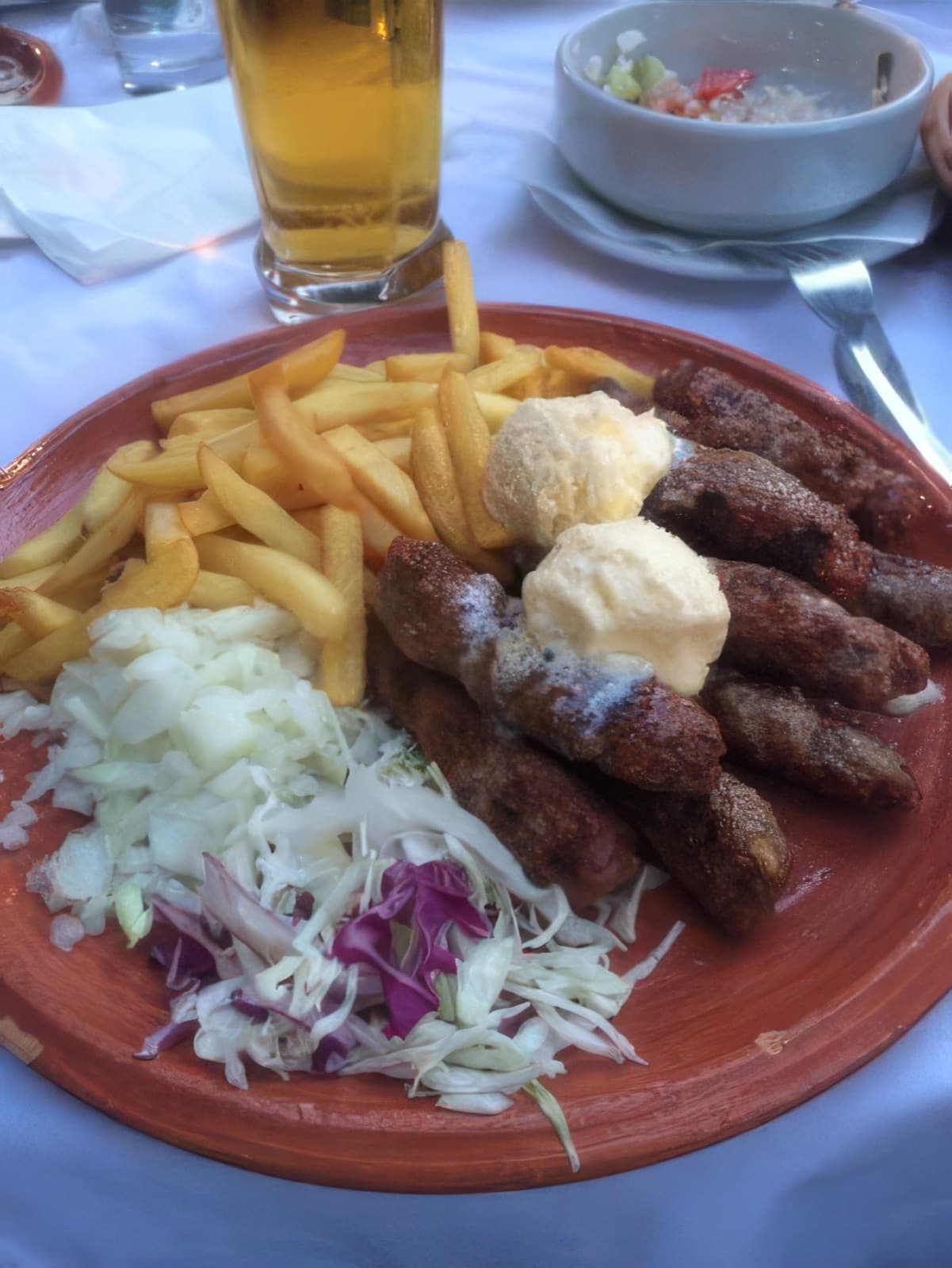
We ate ćevapi most days, with kajmak, and it was cheap, cheaper than we had any reason to expect. Kajmak is made by simmering milk and lifting the skin off it as it forms, layer on layer, then salting what has been collected. It comes to the table white and looks like butter and is not butter.
The proper meal was at Stara Hercegovina, on Carigradska, on the corner where the small park is. Nineteenth-century building. It was called Staro Skopje before it was called this. The food is Herzegovinian rather than Serbian: raštan, pršut, cheese from Zubac, potatoes done the way they do them in Bileća. It is a restaurant and a beer hall in the same rooms, which is how there came to be more than one Lav each that night. Lav means lion.
The two side rooms are named Travunija and Zahumlje, after regions that were principalities a thousand years ago and are now names on a door.
The place opened in 1991. The writer Momo Kapor did the opening, and his photograph hangs on the wall with the others.
On the second night we were kept awake by car horns and shouting that went on for hours.
Serbia had beaten Croatia 11–7 in the Olympic water polo final in Rio. It was Serbia's first gold in the sport, and they took it off Croatia, who had won it four years before.
We lay in a flat named after nine brothers who died at Kosovo and listened to the city celebrate.
The Belgrade Design District turned out to be a run-down shopping centre. Bare units, a few open, most not. Nobody had dressed it up. It seemed about right.
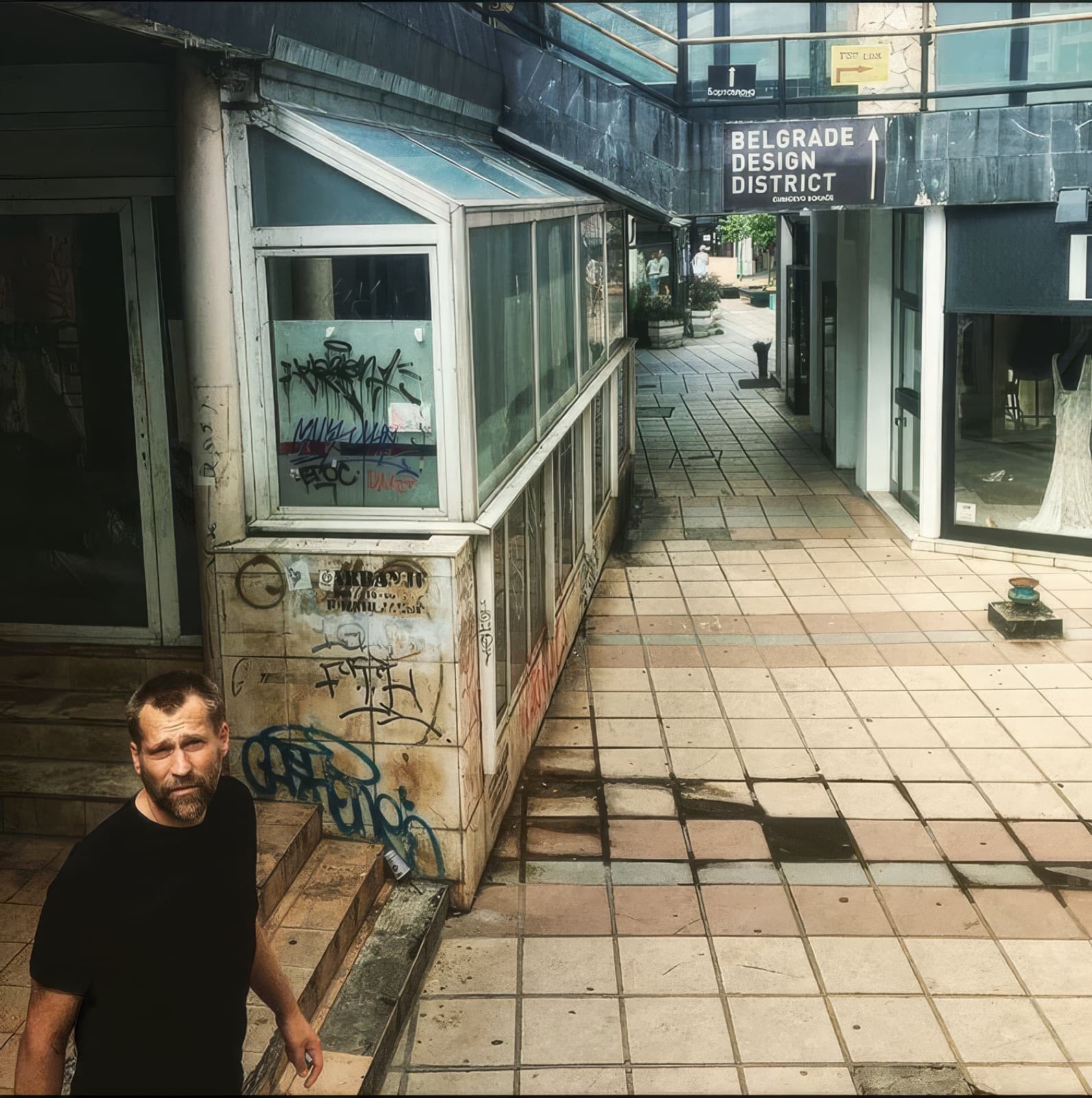
It was built in 1991 as Čumićevo sokače, the first modern mall in the city, and for a short while it was the smart address. Benetton. Imported Italian shoes. Then the imports stopped and the boutiques closed and other businesses took the units. Željko Ražnatović ran a currency exchange out of it called Delije, and people took to calling the place Arkanzas. In the protest years it was useful because it is a labyrinth with ways out onto every main street, so you could lose a police cordon inside it. By the 2000s it was nearly empty. Designers started renting the dead units in 2010.
I have collected football club mugs from cities for years, so on the last day I made the other two come with me to the Red Star shop. There was some discussion about this.
Red Star was founded on 4 March 1945 by the anti-fascist youth alliance, with the interior ministry behind it. Partizan was founded on 4 October the same year by the Yugoslav People's Army. Two arms of one government, seven months apart, each handed a football club. They first played each other on 5 January 1947 and Red Star won 4–3.
The two grounds stand about a kilometre apart. People will tell you the planners put them that close deliberately, so that the thing could never settle. I do not know whether that is true, and I am not sure they do either.
Partizan's supporters organised as the Grobari, the Gravediggers, in 1970. Red Star's organised as the Delije, the Heroes, in 1989, and within a year Željko Ražnatović had them. A derby in 2015 started forty-five minutes late because of what was going on outside the ground. Thirty-five policemen were hurt and forty-one people were arrested.
In this city you are one or the other. It is not a preference and it is not chosen late.
I bought the mug. We flew home.
The hill we did not finish and the blocks we chose from the air. No route, no product — these two are why the Belgrade kit exists.